
Astrology & Metaphysics
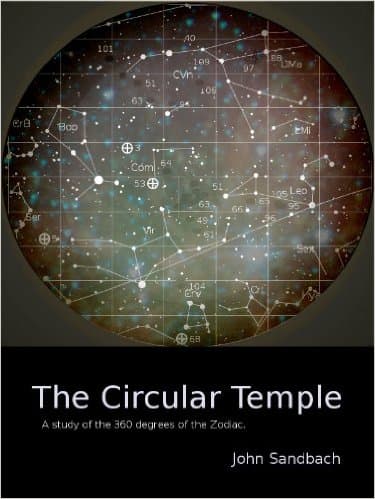
The Circular Temple
A study of the 360 degrees of the zodiac
John Sandbach
The two-volume text of The Circular Temple consists of 1,440 pictorial symbols channeled by John Sandbach over a period of more than twenty years. These symbols are expressed in words rather than visual images, and divided into 4 groups, each one containing 360 symbols. In all 4 groups each of the 360 symbols corresponds to one of the 360 degrees of the zodiac.
Therefore each degree of the zodiac corresponds to four different symbols, one from each group. These four different groups are known as the Omega Symbols, the Pleiadian Symbols, the Chandra Symbols, and the Azoth Symbols.
The first symbol (Omega) signifies the root or foundation of your answer. The second symbol (Pleiadian) signifies the outer appearance and most direct expression of your answer. The third symbol (Chandra) shows how your answer interacts and relates to the world around it. The fourth symbol (Azoth) signifies its highest spiritual significance.
The seed and fulfillment degrees which come after these four symbols show how the symbol relates to other symbols. Read these to get even more information pertaining to your answer. The Angel whose name is given under the Omega Symbol is the Divine Being who rules the degree. In the mystical tradition of Kabbalah there are 72 of these angels. Their names are derived from the Bible.
The Circular Temple has been used by astrologers around the world and hailed as one of the most important esoteric works of astrology.
I think of the use of degree symbols in reading a chart as astrological poetry.John Sandbach
Also on this site
- The 360 Degrees
Every degree of the zodiac, with its Chandra Symbol and John’s interpretation of it, its degree meaning and its angel. Free, on this site.
- The Circular Temple Oracle
Ask a question and draw a degree, the way the book is meant to be used.
- The Omega & Azoth Oracles
The two long passages John wrote for each degree, beside the four symbols.
© 2026 John Sandbach.
Quote or reference this with a link to this page; ask before reproducing it in full.